
Episode 11: Map a research field with OpenAlex
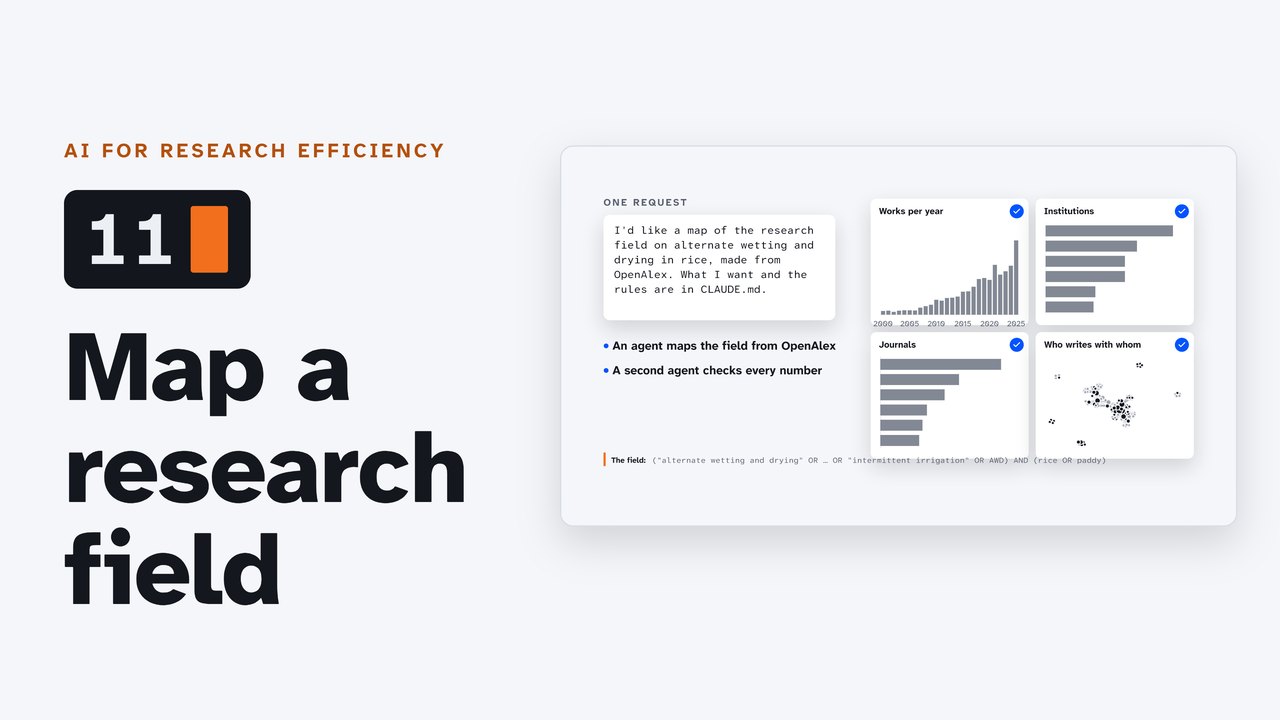
A real, recorded run: an AI agent maps the research on alternate wetting and drying in rice from OpenAlex (works per year, the leading institutions and journals, and who works with whom in Arkansas), a second agent re-checks every count, and the result becomes one page.
Downloads
AI for Research Efficiency, episode 11, with Douglas Hutchings. Narration: an AI-generated voice (ElevenLabs).
One real run, recorded on 4 October 2026: an AI agent (Claude Code, in auto mode) maps the research on alternate wetting and drying in rice from OpenAlex, with no key: works per year, the institutions and journals that publish the most, and who writes with whom in Arkansas. A second agent re-checks every count with its own calls before the page is made. Nothing was staged. Below: the instruction file, the checker's agent file and the request, word for word, so you can run the same thing on your own field.
The instruction file (CLAUDE.md)
Put it at the top of an empty folder. Change the question, the field and the Arkansas part to your own.
# Field map: alternate wetting and drying (AWD) in rice ## The questionWhat does the research on alternate wetting and drying (AWD) in rice look like,On Windows, the folder's Python is .venv\Scripts\python.exe, not .venv/bin/python: change that line, or let the agent set up the environment (then take out "Install nothing", and approve each step it asks about).
The checker (.claude/agents/checker.md)
A second agent with its own instructions, in Claude Code's agent folder. In Codex or Antigravity, ask in your request for a second agent (a subagent) that checks the counts with its own calls, and paste these steps into it.
---name: checkerdescription: Re-checks the field map's numbers against OpenAlex with its own calls,The request
I'd like a map of the research field on alternate wetting and drying in rice,Set it up
A folder with
CLAUDE.mdand.claude/agents/checker.md(above).Python in that folder, with the four libraries the instruction file names:
Windows
python -m venv .venv.venv\Scripts\ pip install requests pandas matplotlib networkx Mac
On a Mac:
python3 -m venv .venv.venv/bin/ pip install requests pandas matplotlib networkx Start your agent in the folder and paste the request. The run in the film took 7 min 32 s.
What the run made
Download the recorded run's files (0.7 MB): the instruction file, the checker, the request (PROMPT.txt) and everything below. Left out: the agent's log and the saved OpenAlex answers (they hold authors' email addresses from their affiliations). To re-run it, run work/scripts/01 to 08 in order (they fetch again from OpenAlex, no key needed), then the checker's work/check/fetch.py and compare.py.
| File | What it holds |
|---|---|
field.md | the query, the counts, what was checked, and what looked wrong |
data/works_per_year.csv | works per year, 2000 to 2025 |
data/institutions.csv, data/venues.csv | the institutions and journals with the most works (ties kept) |
data/arkansas_works.csv, data/coauthors.csv | the works with an Arkansas author, and who wrote with whom |
figures/ | one PNG per view |
checks.md | the checker's comparisons, each with its OpenAlex address |
index.html | the page: four figures, each with its query, the date of the data and the API addresses |
work/calls.csv, work/scripts/, work/check/ | every call with its cost; the scripts (run them in order: the saved answers are left out of the download) |
In this run (OpenAlex, retrieved 4 October 2026): 2,945 works match the query, 2,494 of them from 2000 to 2025; 16 in 2000, 65 in 2010, 325 in 2025. The International Rice Research Institute has the most (138); Agricultural Water Management is the leading journal (109). 44 works have an author at an Arkansas institution (1.5% of the field), with 126 authors and 501 pairs of co-authors. The checker matched every count; it found the year groups add up to 2,920, 25 short of the total (most likely works with no year).
How to check it
- Open the addresses. Every count comes from a URL in
work/calls.csvand under each figure on the page; paste one into a browser and compare. - Read the query and the sample. One search defines the field; the run read 20 random results and said how many sit at the edge. Change the query, and the map changes.
- Read "What looked wrong" in
field.md, then the checker's report, before you share anything. - Check any name you quote. OpenAlex matches authors and affiliations automatically: in this run some researchers had two or three author IDs, and one Arkansas author had none.
What a map like this can and cannot say
- The counts are OpenAlex's matches for one search, not a list of everything published, and not a ranking of quality.
- Recent years are still filling in, and repository and dataset records have grown, so the last years are not directly comparable with earlier ones.
- An institution's count depends on how OpenAlex matched its authors' affiliations (the University of Arkansas's Division of Agriculture, for example, appears under "University of Arkansas System").
What it costs (as of 4 October 2026)
OpenAlex's data is free to reuse (CC0). The API is free to try with no key: $0.10 of usage a day, which OpenAlex counts as 1,000 credits; a page of results costs 1 credit, a search 10, a single record nothing. A free key raises the daily budget ten times. Over the budget, or above 100 requests a second, the API answers 429 Too Many Requests. This run made 47 calls for 112 credits. Keep a key in an .env file, never in the chat (episode 9).
Not confirmed yet
- The same run in Codex CLI and Antigravity CLI (only Claude Code was recorded); their way of defining a second agent.
- OpenAlex's allowances and prices change: read its pricing page on the day.
Sources
- OpenAlex: Authentication (opens in a new tab); Example costs (opens in a new tab); Pricing (opens in a new tab) (the CC0 license); LLM quick reference (opens in a new tab); Other agents (opens in a new tab); Authorships (opens in a new tab). Read 4 October 2026.
- The data: OpenAlex, retrieved 4 October 2026 through its API (CC0). Cite OpenAlex as: Priem, J., Piwowar, H., & Orr, R. (2022). OpenAlex: A fully-open index of scholarly works, authors, venues, institutions, and concepts. ArXiv. https://arxiv.org/abs/2205.01833 (opens in a new tab)
- The run: recorded on the studio's server on 4 October 2026 (Claude Code 2.1.289, auto mode, one checker agent).
Corrections
None so far. If you find something wrong, email doug,@douglashutchings.com.
Transcript
Every spoken line, by chapter
A field map
Who studies alternate wetting and drying in rice, where, and with whom? One request, and an agent maps the whole field from OpenAlex.
Then a second agent checks every number, before anyone sees the page.
AI for Research Efficiency. Episode 11: map a research field with OpenAlex.
Last time, an agent fetched research data through APIs, starting with OpenAlex, which needs no key.
This time, one real run, from a question to a checked map and a page: write the rules, let it estimate and fetch, and check before you share.
The rules
The rules go in an instruction file, as in episode 3: the question, the source, and a budget.
Without a key, OpenAlex gives you 1,000 credits a day. A page of results costs 1; a search costs 10. So the file says: stay under 300, and estimate before paging through anything.
It asks for scripts that re-run, and a log of every address it calls, with what it cost.
And it lists what to make: works per year, the leading institutions and journals, and who writes with whom in Arkansas.
The run
Then the request, and the run begins. The clock is the run's own: 7½ minutes, shown faster.
First it reads OpenAlex's guide for agents. Then it writes one small module that every script shares: it logs each call, and keeps each answer.
One search defines the field
Then one search defines the field: alternate wetting and drying, or intermittent irrigation, or AWD, together with rice or paddy.
It finds 2,945 works. Before going on, it reads 20 of them at random.
All 20 are about rice and its water. About 13 are squarely on the practice, and about 7 sit at the edge. So the search finds the field, with a margin around it.
Cost, as it goes
Every answer states its cost, so it counts as it goes. The counts by year, by institution and by journal are one grouped search each: 10 credits apiece.
A wrong field name was refused for free. And to confirm each institution, it fetched single records, which cost nothing.
Three views
Works per year: 16 in 2000, 65 in 2010, and 325 last year.
The institutions that publish most: the International Rice Research Institute leads, with 138. UC Davis is the only one in the United States on the list.
And the journals: Agricultural Water Management, then Field Crops Research.
Arkansas: who writes with whom
For Arkansas, it never filters by a name. It looks up each institution's OpenAlex number first: 11 records, from Fayetteville to Stuttgart and Jonesboro.
44 works have an author there: 1.5% of the field. 126 authors, and 501 pairs.
Each dot is an author, each line a paper written together. The agent sees two groups: the university with the USDA unit in Jonesboro, on methane and water, and the rice research center in Stuttgart.
What looked wrong
Before any check, it writes down what looked wrong.
Some researchers have two or three OpenAlex profiles, so they appear more than once. One paper lists its four authors twice, and the author with the Arkansas address has no profile at all.
And the last few years jump. The agent notes that more datasets and repository records may be part of it, so recent years aren't comparable with earlier ones.
The checker
Then the checker: a second agent, with its own script and its own calls, that doesn't reuse the first one's code.
Every count matched: 26 years, 16 institutions, 11 journals, the 44 works, and all 501 pairs, rebuilt from scratch.
It found one thing: the yearly counts add up to 25 fewer than the total. Most likely, those works have no year. The agent added that to its notes.
The page
Only then the page: four figures, each with its query, the date of the data, and the addresses to check it.
It's on your computer for now. To share it, put the folder on GitHub and publish it with Vercel, as in episodes 5 and 6.
Read it for what it is
Read the map for what it is. One search defines the field. The counts are OpenAlex's matches, not a ranking of quality. And check any name you quote.
The whole run: 7½ minutes, 47 calls, and 112 credits of the day's 1,000. A free key gives 10 times as many.
Try it
Pause here and try it: copy the instruction file from the companion page, put in your own question and field, and read the checker's report before you make the page.
Review and next
So: define the field with one search, estimate before you page, keep the scripts, and check every number before you share.
Next: make a narrated explainer of your paper.