
Episode 13: How this series is made
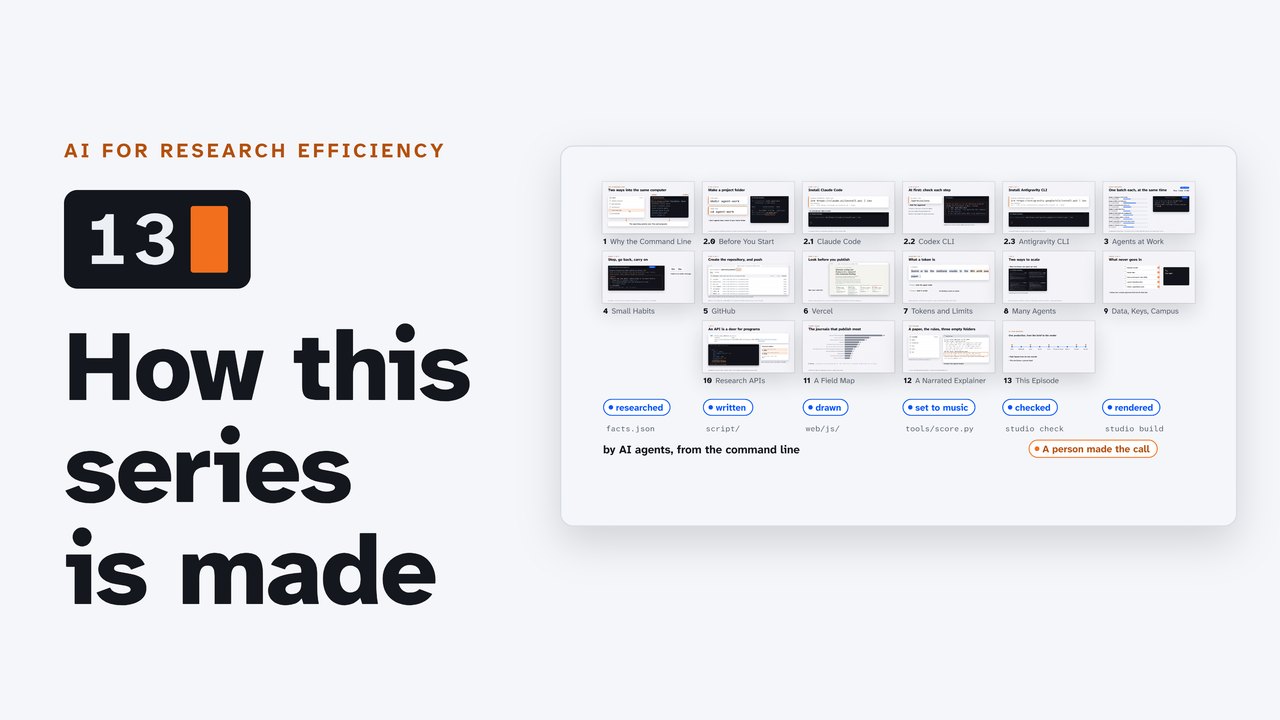
How this series is made by AI agents working from the command line: the brief, research with every fact sourced, three looks and a novelty check, a script on a beat, a voice chosen by ear, pictures and music written as code, ten checks, the review and the render, with real figures from the series' own records.
Downloads
AI for Research Efficiency, episode 13, with Douglas Hutchings. Narration: an AI-generated voice (ElevenLabs).
Every episode of this series was researched, written, drawn, set to music, checked and rendered by AI agents working from the command line, in a studio of tools built for that. A person, the series' owner, made the calls. This page lists the phases, what each one produced, the figures and how each was counted, and the decisions the person kept. Figures as of 4 October 2026, counted from the series' own records.
The phases
| Phase | What the agents do | What it produces | Where a person decides |
|---|---|---|---|
| 1. The brief | turn the owner's request into a brief for each film: subject, audience, purpose, length, where it will be seen | brief.md | the subject and the audience; the length (the research found 90 to 180 seconds too short for the content, and the owner agreed: quality over arbitrary limits) |
| 2. Research | read the sources, keep a dated copy of each page, write every figure and quote into a facts file with its source | facts.json, research/sources.json, research/files/ | |
| 3. The look | draw three looks as style frames; a novelty check compares each new film with the studio's earlier ones | direction.json, style frames | the look (the owner chose Plain Text from three) |
| 4. The script | write each line for the ear; place the lines on a grid of bars at 100 beats a minute; a free local voice reads a draft for the timing | script/ | |
| 5. The voice | cast voices, read the whole script with each, build an audition page | audition/ | the voice, by ear (the owner chose Eric, option 9 of the auditions, for every episode) |
| 6. Picture and sound | write each scene as a small program that draws any moment of the film; write the music and the sound to the same beat | web/js/, tools/score.py, tools/sfx.py | |
| 7. Checks | run ten checks: brand, brief, facts, frame, media, mix, novelty, rights, starters, voice | renders/checks/ | |
| 8. The review | review each film against twenty rules from the research; fix what can be fixed; keep the rest open for the owner | FEEDBACK_LOG.md | what each film stresses (the owner's own notes) |
| 9. Render and deliver | render every frame, then the captions, the chapters, the companion page and an upload kit | renders/ | what may be shown, and when it is published |
What the person decides
- The subject and the audience (the owner's request, 2 October 2026: "a new project focus on 'AI for Research Efficiency'. It will be a series of videos in the 90-180 seconds long. I want it to cover all aspects of 'getting started' through to some relevant examples.").
- How long ("If we need to go over 3 minutes that is fine as we should focus on quality of production / content over any arbitrary limitations.").
- The look: Plain Text, one of three drawn as style frames.
- The voice, by ear: "I like option 9 (Eric - Smooth, Trustworthy)", and "We want to use the same voice for all videos" (3 October 2026).
- What each film stresses: for film 3, "the time it took (~20 minutes) is something that can happen completely unsupervised while you work on something else. That is very fast!" The film's line 37 now says: "The whole review took seventeen and a half minutes, unattended."
- What may be shown, and when anything is published: nothing is published until the owner decides where and when.
- How the rest is made: on 4 October 2026, "Go ahead and proceed through the rest of the videos either sequentially or with parallel processes if it is feasible." Episodes 5 to 13 were then made at the same time, one agent per episode; this episode is one of them.
The figures, and how each was counted
Counted on 4 October 2026 at 20:04 UTC by the episode's own tool (tools/series_figures.py), from the series' records, with all sixteen films finished and registered in the studio's ledger: 1, 2.0, 2.1, 2.2, 2.3, and 3 to 13. This episode counts itself: its own length, lines, facts and credits are in the totals, counted after its last change (version 1.1), so the totals describe the whole series as it stands. The spoken count of review notes is worded to stay true as notes are added ("more than two hundred, and most are already fixed"); the screen shows the exact split.
| Figure | How it was counted |
|---|---|
| 16 films, this one included | episodes of the series registered in the studio's ledger |
| 1 h 19 min 48 s of film (about eighty minutes) | the sixteen films' timelines added up (4,788.0 s) |
| 548 narrated lines | the lines in the sixteen films' narration files |
| 456 facts | the entries in the sixteen films' facts files, each with a source |
| 201 review notes: 152 fixed, 48 open, 1 set aside | every film's review notes: Part 1's (each film's own and the shared ones, counted once) and each later episode's own |
| 18 voices cast, 12 read in full | film 1's casting file and its narration log (six voices from the shared library could not be read: the key lacked the permission) |
| 18 agents, 17 min 29 s | film 3's run record: the lead agent and 17 helpers (8 readers, 8 checkers, a writer), unattended |
| 10 checks | the checks studio check runs on a film |
| more than 19,000 frames in 2.7 minutes | episode 4's render log: 19,440 frames; the whole build, from the sound to the MP4, took about nine minutes |
| 3 h 49 min | from the series' first commit (2 October 2026, 20:52 UTC) to the commit with all six Part 1 films rendered (3 October, 00:42 UTC) |
| 8,376 ElevenLabs credits | every paid request in the sixteen films' narration logs, the auditions and this episode's re-reads included |
| 25 commits, 6 engine releases | the git history of the series folder (at commit 2efff4d); the engine's changelog, 2 to 4 October 2026 |
| 11 earlier films | the studio's other films in its ledger, which the novelty check compares each new film with (not named) |
What the episode shows of the studio
The studio's commands (studio facts check, studio direction check, studio check, studio build), recorded on 4 October 2026 in a scratch copy of episode 4 outside the repository (the scratch path shortened on screen); this series' own files (a brief, a fact and its source, a narration line, a scene's code, a mix report, review notes, a render log); frames from the series' own films and its style frames. No keys, no account details, no other client's or project's work.
Not confirmed yet
- How much of the studio the published episode should show is the owner's call: the list above is what this cut shows.
- The figures are a snapshot of 4 October 2026, 20:04 UTC; the owner's review will add notes, and may change lengths and lines.
Try it
- Write a brief for your own project: subject, audience, goal and length.
- Have your agent research it, every fact with its source.
- Keep the decisions for yourself: what it says, how it looks and sounds, what may be shown, and when it goes out.
Sources
All of them the series' own records, read on 4 October 2026: the series plan (SERIES.md: the owner's words and the decisions), the plan for episodes 4 to 13 (NEXT_EPISODES.md), film 1's brief, facts, sources and narrator auditions, the three looks (look/LOOKS.md), the best-practice rules (research/parts/best-practices.md), film 3's run record and script, episode 4's script, timing, scene code, mix report and render log, Part 1's review notes, the studio's ledger, the git history and the engine's changelog. The figures: research/files/figures.json.
Corrections
None so far. If you find something wrong, email doug,@douglashutchings.com.
Transcript
Every spoken line, by chapter
How this series is made
Every episode of this series was researched, written, drawn, set to music, checked and rendered by AI agents, working from the command line.
And at each turn that mattered, a person made the call.
AI for Research Efficiency. Episode 13: How this series is made.
So far, this series has shown agents at work on research. This time, the work is the series itself.
In this episode: one production, from the brief to the render, with real figures from its own records, and the decisions a person kept.
1. The brief
One: the brief.
It began with a few lines from the owner: a series on AI for research efficiency, 90 to 180 seconds a video, from getting started to real examples.
The agents turned that into a brief for each film: the subject, the audience, the purpose, the length, and where it will be seen.
Then the research found that too short for the content, and the owner agreed: quality over arbitrary limits.
2. Research, every fact sourced
Two: research, with every fact sourced.
Every figure and quote, on screen or spoken, goes into a facts file, with its source and the day it was read.
A check compares the script and the screen with that file, and flags anything it can't find. The sixteen films carry 456 facts.
3. Three looks, one choice
Three: three looks, one choice.
The agents drew three looks as style frames: Plain Text, Signal Blue, and Lab Notebook. The owner chose Plain Text.
Then a novelty check compares each new film with the studio's earlier ones, so no two look alike. A series may share its own style.
4. A script on a beat
Four: a script, on a beat.
Each line is written for the ear, then placed on a grid of bars at 100 beats a minute, so the words, the picture and the music land together.
A free local voice reads a first draft, just for the timing.
5. A voice chosen by ear
Five: a voice, chosen by ear.
For the first film, the agents cast 18 voices, and read the whole script with 12 of them.
The owner listened, and chose option 9: Eric. That's the voice you're hearing now, in every episode.
6. Pictures and music as code
Six: pictures and music, written as code.
Each scene is a small program: give it a moment in time, and it draws that frame. A browser renders 60 frames for every second of film.
The music is code too, on the same beat, and every key click lands on the frame where a key is pressed.
7. Ten checks
Seven: 10 checks.
The brand, the facts, the rights to every image and sound, the mix, the frames, and more. Each must pass, or warn with a stated reason.
The mix check, for one, wants every spoken line at least 19 decibels above the music.
8. The review and the fixes
Eight: the review, and the fixes.
Each film is then reviewed on its stills, against 20 rules from the research. Across the sixteen films, the reviews drew more than 200 notes, and most are already fixed.
The owner adds notes too. Film three now says its review ran unattended, because the owner asked for it.
9. Render and deliver
Nine: render, and deliver.
Drawing episode 4's frames, more than 19,000 of them, took under 3 minutes. Then come the captions, the chapters, a companion page, and an upload kit for YouTube.
Nothing is published until the owner decides where, and when.
What the person decides
So, what does the person decide?
The subject and the audience. The look. The voice, by ear. What each film stresses, what may be shown, and when it goes out.
And on 4 October, one more: make the rest of the series side by side. Nine agents worked at the same time, one episode each, and this episode is one of the nine.
By the numbers
By the numbers, with all sixteen films finished, this one included: 80 minutes, and 548 narrated lines.
Film 3's review alone took 18 agents 17 and a half minutes. And the first six films went from the first commit to rendered in under 4 hours.
Try it
Pause here, and try it. Write a brief for your own project: subject, audience, goal and length. Ask your agent to research it, every fact sourced, and keep the decisions for yourself.
Review and next
So: agents do the work, checks catch the slips, and a person makes the calls.
That's the series. Next: your own project.