
In Practice: Ask for the process, not the answer
Before asking an AI agent for an answer, ask it for the best way to get one. On 901 comments that researchers wrote about peer review, the agent interviews you, helpers lay out the options, a reviewer tests them on real comments, you choose, and the method is saved as a skill before anything is coded. Then it runs twice, and a sample coded by hand shows how far it repeats.
Downloads
AI for Research Efficiency, In Practice, with Douglas Hutchings. Narration: an AI-generated voice (ElevenLabs).
One research question, asked two ways. Asked for the answer, three fresh agent sessions read the same 901 survey comments and came back with their own themes, counts and headlines. Asked for the best way to find out what the researchers think, an agent interviewed the researcher, three helpers laid out the options, a reviewer tested them on real comments, the researcher chose, and the method was saved as a skill before anything was coded. Then it ran twice, in two separate sessions, and the studio measured how far the coding repeated. Recorded on 28 October 2026 on the studio's Linux server with Claude Code 2.1.312 and Codex CLI 0.164.0, each run in a folder of its own. Antigravity was not recorded (see "Not confirmed yet"). The same steps work on any task you would otherwise ask an agent to "just analyze".
1. Two ways to ask
The request for an answer (the film's three naive sessions: Claude Code once, Codex twice):
Analyze the comments in peer-review-2016/The request for the process. Switch to plan mode first (section 2), then:
The file peer-review-2016/After the interview, the options and the review (in the film it went in as feedback on the agent's first plan):
Before we choose,Then choose, and freeze the choice before anything is coded:
I'll take <the option you chose>. Before coding anything,Check the first batch yourself, then let it run. The researcher's check in the film, word for word:
That looks right. Keep the 17 codes and your double-blind rule,Then, in a fresh session with nothing but the saved skill:
Use the survey-coding skill to code every comment in peer-review-2016/Keep it to three helpers and one reviewer: Anthropic measured teams of agents using about 15 times the tokens of a chat (its multi-agent research post, 2025). The tools' built-in team modes (Claude Code's dynamic workflows, Antigravity's /boost and /teamwork-preview) are shortcuts on paid plans, not requirements: every step above works in plain words.
The researcher's answers to the interview were written in advance by the studio from the owner's stated method and the film's brief, and typed by the recorder; where the brief did not cover a question, the researcher took the agent's recommended answer.
2. Plan mode and the interview, in each tool
| Claude Code | Codex CLI | Antigravity CLI | |
|---|---|---|---|
| Plan mode | Shift+Tab until the status bar shows ⏸ plan mode on, or /plan before a prompt | Shift+Tab, or /plan | Shift+Tab to plan, or /plan; agy --mode=plan to start in it |
| The interview | in your prompt: "Interview me in detail using the AskUserQuestion tool" ("For larger features, have Claude interview you first") | in your prompt ("Ask Codex to interview you ... Tell it to challenge your assumptions") | /grill-me: "the agent asks one question at a time and recommends an answer for each"; /plan /grill-me <task> combines the two |
| Approve the plan | choose a "Yes" option, or "Tell Claude what to change" and Shift+Tab to approve with your feedback (what the film did) | ask it to revise the plan in chat, then go on | comment on the plan, then Proceed |
The keys are the same on Windows (Windows Terminal) and on a Mac (Terminal). Read on each vendor's own pages on 24 and 27 October 2026; versions change often.
3. The skill: survey-coding
A skill is a folder with a SKILL.md file that tells an agent how to do one kind of task; all three tools read the same format (the open Agent Skills standard). The one on this page codes open-ended survey answers so the result can be defended and repeated: a codebook built from a seeded random sample and frozen in a written protocol before any coding, every answer coded against it, a second independent run, and agreement measured per code.
survey-coding/ SKILL.md the procedure (steps 0 to 8) references/Download the folder, survey-coding.zip, and put one copy where each tool looks, inside your project folder: .agents/skills/ (Codex and Antigravity) and .claude/skills/ (Claude Code). Use a copy, not a link, on Windows.
Windows
Windows (PowerShell, in your project folder, with survey-coding unzipped beside it):
New-Item -ItemType Directory -Force .agents\Mac
Mac (Terminal, in your project folder):
mkdir -p .agents/Run it: in Claude Code, /survey-coding, or ask for it ("Use the survey-coding skill..."); in Codex, $survey-coding or /skills; in Antigravity, /survey-coding (it turns each skill into a command). Before you trust it, try it in a fresh session on a few answers you know well.
What the recorded run's own skill did differently. The run wrote its skill from the conversation, and it went further than this page's: it codes each comment with a fresh call to Claude (claude -p, no tools, no settings, no session) so that no comment's coding depends on another's, archives every raw answer as the record, codes a stance for each of the survey's seven parts of open peer review, and refuses to code the held-out comments until the person's hand codes exist. That makes it Claude-specific: Codex followed it step by step in the film's "next month" run, but its coding step calls Claude. This page's version codes in the session itself, in any of the three tools.
The skill's files, in full:
survey-coding/SKILL.md
---name: survey-codingdescription: "Codes open-ended survey answers in a way that can be defended and repeated: a codebook built from a seeded random sample and frozen in a written protocol before any coding,survey-coding/references/protocol.md
# Protocol: <the study,survey-coding/references/codebook.md
# Codebook: <the study>,survey-coding/scripts/agreement.py
"""agreement.py: how far two codings of the same answers agree,4. The protocol and its decision log
The protocol is the method written down before the results exist, as a preregistration is: the question, the data and how it was counted, the method and the options turned down, the codebook's sample and seed, the two runs, the agreement measures and the threshold you accept, decided before you see any figure. After the freeze, nothing above the decision log changes; every change of plan becomes a row of the log, with its date, its reason and who agreed. Plans do change: a review of every preregistered study in one psychology journal found that all of them had departed from their plan (Claesen et al., 2021).
The film's run kept 35 rows in its log, each marked R (the researcher) or C (the agent). Two changes came before the freeze: one coding call per comment instead of three with a majority vote (the researcher's, for cost: the first pilot's three calls a comment cost $5.12 for 50 comments at list prices), and two codes added after a random pilot of 50 comments put 28% of the substantive ones under "other" (EVIDENCE_FIRST, "test open peer review before adopting it", and NO_IMPROVEMENT, "the current system works"). The codebook was then frozen with 19 reason codes and three fixed ones. The template is survey-coding/references/protocol.md.
5. The practice folder
The practice folder, process-practice.zip (about 1.2 MB unzipped). Two surveys of researchers, both under CC BY 4.0:
peer-review-2016/: the 901 answers to "Do you have any other comments?" and the 456 answers to "If you do not agree, why?" from the OpenAIRE Open Peer Review Survey 2016 (Ross-Hellauer, Schmidt and Deppe; Zenodo, doi.org/10.5281/zenodo.439531 (opens in a new tab)), each with the respondent's discipline; the survey's readme and questionnaire.open-data-2023/: 2,409 researchers' reasons for their stance on a national open-data mandate, from the State of Open Data Survey 2023 (Springer Nature, Figshare and Digital Science; figshare, doi.org/10.6084/m9.figshare.24517123.v2 (opens in a new tab)). The published file also holds each respondent's device location and institution name; neither is in the practice folder (itsREMOVED.mdlists everything that was taken out, and why).
To open a CSV in Excel on Windows: Data > From Text/CSV, and choose UTF-8 (the 2023 file has Chinese and Japanese answers). On a Mac, Numbers opens it directly. MANIFEST.csv lists every file with its source, license, checksum and what was changed; README.md gives a credit line to copy if you share them.
What to keep in mind about the 2016 survey: it over-represents the earth and environmental sciences (1,274 of its 3,062 respondents, after one publisher's mailing list brought in almost a third of the responses in a single day), the authors allow for "some self-selection", and it dates from 2016. In the film's run only four fields had 30 or more substantive comments, so results by discipline can compare those four at most.
6. Measuring agreement
Coding a comment is a judgment, so two runs will not give identical files; what you can report is how often they agree. scripts/agreement.py compares two codings of the same answers, code by code:
python scripts\(on a Mac, python3 and forward slashes). For each code it gives how many answers each side used it for, the percent agreement, and Cohen's kappa: agreement after discounting what two coders would reach by chance with the same rates (1 is perfect, 0 is no better than chance). Kappa is unstable for rare codes, so read it beside the counts. Choose the kappa you will accept before you see any figure, and write it in the protocol.
In the film's run (computed by the studio from the two runs' files, 28 October 2026): run 1 and run 2 each coded the 821 comments outside the 80 held out for a hand check, one fresh call per comment, in about 15 minutes each ($33.86 and $26.32 at list prices, as claude -p reported them; on a monthly plan these draw on the plan's limits instead). They made the same decision on 99% of 25,451 coding decisions (821 comments, 31 each: the non-answer flag, a stance for each of eight parts, 22 codes). Kappa averaged 0.94 over the 22 codes (lowest 0.84, for "other", the catch-all) and ran from 0.91 to 0.97 for the stances; the non-answer flag agreed every time. Still, 81% of comments were coded identically in every field: about one in five differed somewhere. The run's own report agrees: kappa 0.83 or more for every field, and 81% of comments identical.
What agreement does not show. Two runs of the same model with the same codebook can repeat the same mistakes. Agreement shows the method repeats; whether the codes are right is the next check: a sample you code by hand, before you look at either run, compared with the same script and --ids. The film's held-out 80 comments are drawn for that check; it has not been made yet.
For a sense of scale: in one study of closed categories, two ChatGPT runs agreed on 91% and 97% of labels (at two settings), and trained annotators on 79% (Gilardi, Alizadeh and Kubli, 2023). In another, the same instructions in separate ChatGPT conversations produced open coding schemes with 5 to 13 categories (Bijker et al., 2024).
7. One trap to check
Count your answers with a reader that keeps every answer as text. Read with pandas' default settings, the 2016 comments lose 18 answers ("None" 13 times, "NA" twice, "N/A" twice, "n/a" once), which pandas treats as missing: 901 becomes 883. Use pd.read_csv(..., keep_default_na=False), or Python's csv module, and compare your count with the one the authors published (901 in the paper). None of the film's recorded sessions fell into it: every one counted 901.
8. The line not to cross
- Your own work, and data you may share with these services. Protected data (identifiable participants, health or student records, anything under an agreement) stays out of cloud tools: episode 9 covers your campus's rules and the local options.
- Claim discovery modestly: helpers widen the menu, and you choose. In one study, research ideas from language models were rated more novel than experts' ideas, and the gap closed once the ideas were carried out (Si, Yang and Hashimoto, 2024; Si, Hashimoto and Yang, 2025).
- A reviewer asked to find problems will usually find some: "A reviewer prompted to find gaps will usually report some, even when the work is sound" (Claude Code's best practices). Give it something real to test against, and ask only for problems that would change the result.
- Watch the usage: a skill that makes one model call per answer multiplies quickly. In the film, the plan's weekly limit stopped the run for two hours during a pilot; it carried on by itself when the limit reset.
The run, in numbers
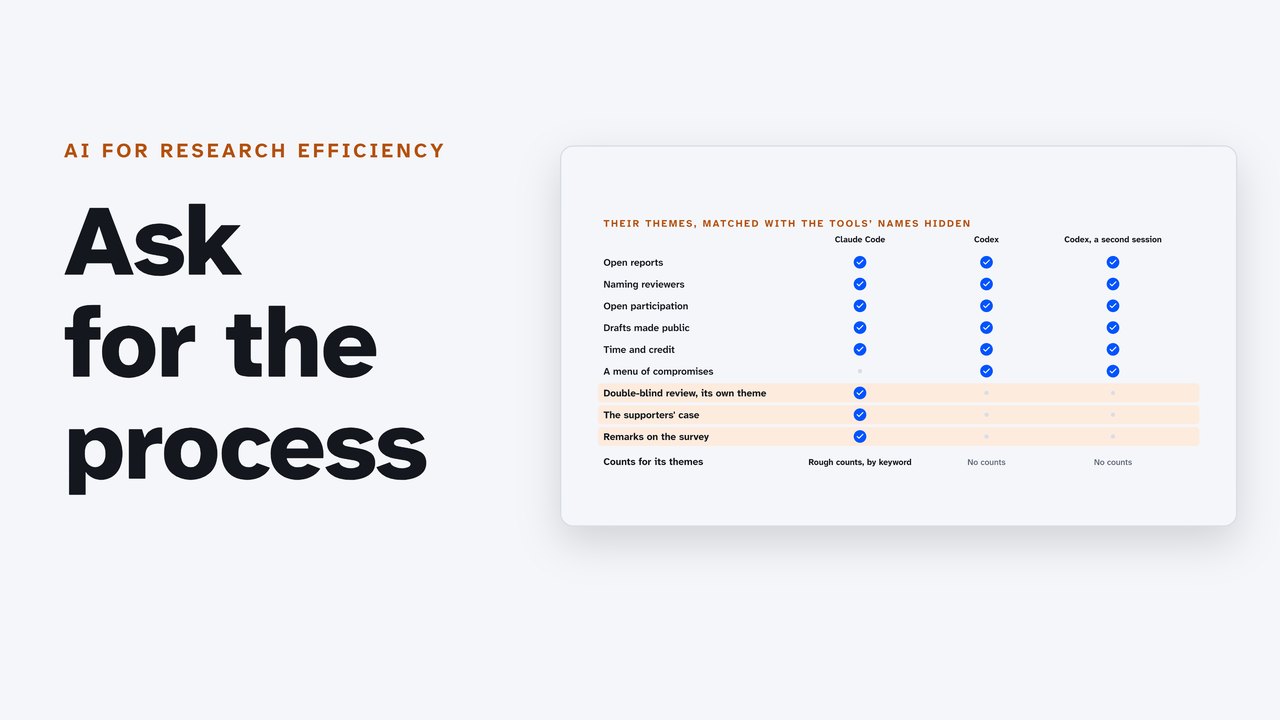
| The three naive answers | Five broad themes shared by all three (matched with the tools' names hidden). One answer (Claude Code's) gave rough counts by keyword, counted 176 empty answers, and made double-blind review a theme of its own; the two Codex sessions gave six themes each and no counts. Headlines: "mixed and mostly conditional"; "divided and depend on the form of openness"; "divided, often conditional" |
| The interview | Eight questions in two rounds; one answer changed the plan: next month's survey is on another topic, so what must repeat is the procedure, not a list of themes |
| The options and the review | Three helpers: an agent coding against a frozen codebook; people coding by hand (about 45 to 58 hours of the researcher's time per survey); a topic model. The reviewer, on 60 comments outside the held-out set: one for-or-against code does not fit; how requests for double-blind review are counted moves "oppose" from 24% to 31%; the comments were analysed and published in 2017 (PLOS ONE); the topic model's clusters barely repeated (agreement 0.02 to 0.12) |
| The codebook | 19 reason codes and three fixed codes, from seeded batches of 200, 100 and 100 comments (seed 20261028), the held-out ids left out; frozen as v1 after two pilots |
| Run 1 and run 2 | 821 comments each, one call per comment, about 15 minutes each |
| Agreement between the runs | 99% of 25,451 decisions; kappa 0.94 on average (lowest: "other", 0.84); 81% of comments identical in every field |
| Next month (2023 survey, Codex) | The same skill: it confirmed the stance target with the researcher, reserved 80 answers for a hand check, drafted 24 reason codes from 400 answers, and stopped for the researcher's review, as the protocol says |
Why this works: the evidence
- The same question gets different answers. Anthropic: "Even with temperature set to 0, the results will not be fully deterministic"; OpenAI: "Determinism is not guaranteed". None of the three tools' settings pages lists a temperature setting (searched 24 October 2026).
- People do it too. Twenty-nine teams given one data set and one question estimated the effect from 0.89 to 2.93 (odds ratios); 20 teams found it significant and 9 did not. The authors: "defensible, yet subjective, analytic choices influence research results" (Silberzahn et al., 2018). A 2026 preprint finds that AI analysts' "independent runs frequently reverse whether the hypothesis is judged supported" (Bertran, Fogliato and Wu; not peer-reviewed when read).
- Fixing the plan first is what researchers already do. Preregistration: to "define the research questions and analysis plan before observing the research outcomes" (Nosek et al., 2018). In psychology, papers accepted before their results were known reported a positive first result 44% of the time, against 96% for standard papers (Scheel, Schijen and Lakens, 2021).
Not confirmed yet
- Antigravity was not recorded. On the studio's server the account's own Antigravity settings skip every approval (the setting the
--dangerously-skip-permissionsflag sets), and a separate installation with approvals on stops at Antigravity's first-run "Terms of Service & Data Use" screen. Both are the owner's to decide, so the third naive session is a second Codex session, and Antigravity's two takes wait for a run by the owner. - A person's hand-coded sample is the next check of the film's coding: the 80 held-out comments are drawn and kept out of everything; nobody has coded them yet.
- Tested on the studio's Linux server only: the PowerShell lines above, Windows' handling of the skill folders, and Excel's reading of the CSVs are not yet confirmed on a Windows PC or a Mac.
- Whether a Windows directory junction works as a skill folder for Claude Code is not documented (hence the copy).
- Whether Codex and Antigravity read
.claude/skills/is not documented; Claude Code does not read.agents/.
Sources
- The data: OpenAIRE Open Peer Review Survey 2016 (opens in a new tab) (CC BY 4.0); State of Open Data Survey 2023 (opens in a new tab) (CC BY 4.0); the license (opens in a new tab).
- The authors' analysis: Ross-Hellauer, Deppe and Schmidt (2017), Survey on open peer review (opens in a new tab), PLOS ONE 12(12): e0189311 (CC BY 4.0).
- The recorded runs (28 October 2026): the studio's recordings and the runs' own files, kept with the film's project; the agreement figures computed by the studio from the runs' coded files.
- The tools (read 27 October 2026): Claude Code best practices (opens in a new tab), permission modes (opens in a new tab), skills (opens in a new tab); Codex best practices (opens in a new tab), slash commands (opens in a new tab), skills (opens in a new tab); Antigravity plan (opens in a new tab), /grill-me (opens in a new tab), modes (opens in a new tab), skills (opens in a new tab); the Agent Skills specification (opens in a new tab).
- The evidence: Anthropic, temperature (opens in a new tab); OpenAI, seed (opens in a new tab); Bijker et al. 2024 (opens in a new tab); Silberzahn et al. 2018 (opens in a new tab); Bertran, Fogliato and Wu 2026 (opens in a new tab) (preprint); Anthropic's multi-agent research system (opens in a new tab); Nosek et al. 2018 (opens in a new tab); Scheel, Schijen and Lakens 2021 (opens in a new tab); Claesen et al. 2021 (opens in a new tab); Gilardi, Alizadeh and Kubli 2023 (opens in a new tab); Si, Yang and Hashimoto 2024 (opens in a new tab); Si, Hashimoto and Yang 2025 (opens in a new tab).
Corrections
None so far. If you find something wrong, email doug,@douglashutchings.com.
Transcript
Every spoken line, by chapter
Three answers, one question
Three agent sessions got the same nine hundred and one survey comments, and the same request: tell me what researchers think.
They agreed on five broad themes. Only one put numbers on them, and only one made double-blind review a theme of its own.
With the method chosen and written down first, two separate runs agreed on ninety-nine percent of their coding decisions.
AI for Research Efficiency, In Practice. Ask for the process, not the answer.
In this film, an agent helps you choose the best way to do a research task, and saves it as a skill for next month.
It builds on episodes three, four, seven and eight.
Why the answers differ
Ask twice and the answers differ. In one study, ChatGPT given the same instructions in separate conversations produced coding schemes with five to thirteen categories.
Anthropic and OpenAI both document this, and none of the three tools lists a setting to stop it.
People vary too. Twenty-nine teams of analysts, given one data set and one question, produced estimates from zero point eight nine to two point nine three: twenty found a significant effect, and nine did not.
A twenty twenty-six preprint finds that A I analysts' independent runs "frequently reverse whether the hypothesis is judged supported."
1. Ask for the process
So begin with a different question, in plan mode: Shift and Tab, or slash plan, in all three tools.
What is the best way to find out what these researchers think, in a way I could defend in a methods section and repeat next month? Don't analyze yet.
Then let it interview you. In Claude Code and Codex you ask for the interview in plain words; Antigravity has a command for it, slash grill me.
Here it asked eight questions. One answer changed the plan: next month's survey is on another topic, so the procedure, not a list of themes, is what must repeat.
2. Lay out the options
Next, three helpers each research one way to do the job, side by side.
One made the case for an agent coding against a fixed codebook, one for people coding by hand, and one for a topic model.
Keep the team small: Anthropic measured teams of agents using about fifteen times the tokens of a chat.
3. Test them on real comments
Then a reviewer tries each option on a sample of the real comments, and reports only the problems that would change the result.
Put that last part in your request: Claude Code's guide warns that a reviewer asked for gaps will usually report some, even when the work is sound.
On sixty real comments, it found that one for-or-against code does not fit, and that how requests for double-blind review are counted moves opposition from twenty-four to thirty-one percent.
It also found that the survey's authors had published an analysis of these same comments, in twenty seventeen.
4. Choose, and write it down
Now you choose. Here, the agent codes against a codebook: coding by hand would take about fifty hours, and the topic model's clusters barely repeated.
Before a single comment is coded, the agent writes the method down: a protocol with a decision log, and a codebook of nineteen reason codes.
Researchers call this preregistration. Plans still change, so each change goes in the log: in one journal, a review found that every preregistered study had departed from its plan.
This run changed two things before the freeze: one call per comment instead of three, to keep the cost down, and two new codes that a random pilot showed were missing.
Then it saves everything as a skill: a folder in dot agents slash skills for Codex and Antigravity, with a copy in dot claude slash skills for Claude Code.
5. Run it, then run it again
Check the first batch yourself, then let it run.
Run one coded eight hundred and twenty-one comments, each in a fresh call, in about fifteen minutes.
Then a fresh session, with nothing but the saved skill, codes every comment again.
6. Check it against something outside the agent
Here, the two runs agreed on ninety-nine percent of their coding decisions, and kappa, which discounts agreement by chance, averaged zero point nine four. Still, about one comment in five was coded differently somewhere.
That shows the method repeats. It does not show the codes are right: for that, compare them with a sample you code by hand.
So for a judgment like this one, the same result means an agreement rate you measure and report.
The paper is a check too: it counts nine hundred and one comments, as the file does, and the view it reports, double-blind review to cut bias, is the run's code for bias about authors, in fifty-five comments.
One trap: open the file with pandas, a popular Python library, on its default settings, and answers like None and N A become blanks. Nine hundred and one turns into eight hundred and eighty-three.
Another field, and next month
By discipline, four fields have thirty or more substantive comments here, and their top reasons differ, often by just a few comments.
Read that with the survey's limits in view: one thousand two hundred and seventy-four of its three thousand and sixty-two respondents are earth and environmental scientists. The authors allow for some self-selection, and the survey dates from twenty sixteen.
And next month looks like this: the same skill, in Codex, on a newer survey of about two thousand four hundred researchers' reasons for their stance on a national open-data mandate. It drafted twenty-four reason codes, and stopped for the researcher's review, as the protocol says.
The line not to cross
Use this on your own work, and on data you may share with these services; episode nine covers protected data.
And claim discovery modestly: helpers widen the menu, and you choose. In one study, ideas from language models were rated more novel than experts' ideas, and lost that edge once carried out.
Try it
Pause here and try it. Before your next analysis, ask your agent: what is the best way to do this? Don't do it yet.
Review and next
So: ask for the way, test the options, choose, write it down, and measure how far it repeats.
The skill and the practice folder are on the companion page.
This shelf of films was planned the same way: helpers researched which films would help researchers most, and a person makes the call.
Next on this shelf: make a slide deck that looks like yours.